
Progressives, Please Hear Me Out

In my late teens and early twenties, I was quite progressive—or, as some might say today: woke.
I saw capitalism as fundamentally oppressive, jobs as alienating, and the entire ‘system’ as a sprawling web of exploitation, particularly targeting minorities—with me inevitably complicit, whether I liked it or not. In my mind, the West was an imperialist juggernaut, projecting its hegemony across the globe, with other nations but powerless victims to our whims.
I was also skeptical of the very concept of truth. Whose truth? Mine? Yours? It all seemed like a contest of competing narratives, each side guzzling its own brand of propaganda but none as powerful as the one of the West. I leaned into moral relativism, believing no one had the right to judge what happens in another culture, no matter how uncomfortable it might seem from the outside.
Was this the full ideological starter pack? Maybe not, but it gives you a snapshot of where my head was at back then.
Being a progressive, I met like-minded friends and moved within progressive circles. My experience has never aligned with the caricature of progressives as hateful, envious people determined to destroy humanity. On the contrary, progressives have always struck me as people who care deeply, sometimes to the point of exhaustion.
They’ll sign up for rescue missions in the Mediterranean, volunteering to save migrant boats at sea. They’ll commit their time to charity work, join protests in the rain, and sit through endless, jargon-filled lectures by critical theory professors—all because they believe in something bigger than themselves.

Progressives don’t buy into the conventional structures of society or the demands of corporate life, they see large parts of society as fundamentally broken. Many feel like they’re fighting a losing battle, yet they keep going—not out of hope for victory, but because they believe it’s the right thing to do. I’d be lying if I said there wasn’t a part of me that admires the dedication I’ve seen in some progressives.
It’s not easy to be a progressive. Believing that much of society is rotten to the core is psychologically taxing. It’s no secret that people on the left report higher rates of mental health struggles compared to the general population
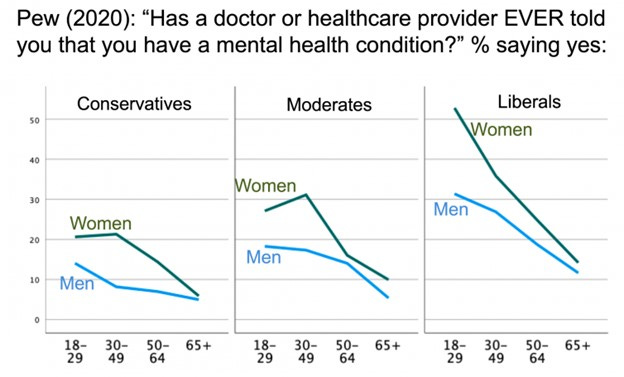
Moreover, much of the progressive struggle is against human nature itself—challenging ingrained biases, resisting self-interest, and pushing back against cultural norms we’re naturally inclined to conform to. Some of these battles are noble, requiring relentless introspection and a rejection of comfort and complacency. In this light, progressives strike me as far more principled and sympathetic than the far right, which often seems driven by a surrender to primal instincts; a Dionysian power fantasy fueled by the pursuit of dominance, control, and unfettered will.
However, the minds of progressives are often rife with apparent contradictions, creating forms of cognitive dissonance that may contribute to taking a toll on their mental health.
Progressives tend to reject hierarchies but navigate them constantly—in conversations, romantic relationships, and the social structures they create within their own communities.
They believe—with merit—that all humans are essentially equal, yet often react defensively if someone suggests that non-Western people might share some of the same flaws as Westerners.
Sometimes political discourses or reports are framed as narratives, with no capital-T 'Truth.' Yet the progressive narrative is presented as uniquely correct.
Inclusivity and tolerance are central values—but not extended toward right-wing perspectives, which are often considered beyond the bounds of acceptable discourse.
In many circles, identity is considered fluid, personal, and subjective. Yet, in the same circles, people are understood and categorized through fixed group identities such as race, gender, and class.
Objective morality is sometimes dismissed as an archaic, logocentric imposition, yet progressives frequently treat certain moral claims as obviously true.
The reason for these apparent contradictions is that progressivism isn’t guided by a singular, rigorous doctrine or analytically derived system. While certain thinkers have undoubtedly shaped its ethos, its principles and unwritten rules are transmitted diffusely through cultural signals and college chatter. This vagueness is compounded by certain progressive academics, often those associated with the critical theory tradition, whose opaque writing style leaves passages ambiguous, frequently masking internal contradictions. As a result, many progressives tend to lack clear epistemic standards and a coherent, unanimous moral theory to anchor their worldview. But this isn’t much of a problem for the strange patchwork of progressivism, since ambiguity isn’t seen as a vice in the progressive world—it’s more of a virtue.
The best I can distill as a normative framework guiding progressive ethical judgments—or at least the one that guided mine—is the absolutization of the oppressor-oppressed distinction into two core dogmas:
The powerful are always the oppressors, and the weak are always the oppressed.
The oppressed can do no wrong, while the oppressors can do no right.
Taken together, these dogmas collapse into a simple moral rule: The powerful are always bad.
This informal, unwritten surrogate moral theory likely stems from an extremization of the implicit normative standards baked into critical theory, which seeks to critique, and dismantle power structures. Through this lens, progressive ethical reasoning becomes fairly predictable: America? Powerful, therefore always oppressive. Minorities? Disadvantaged by the power dynamic, therefore beyond reproach. Big corporations? Instruments of domination, tear them down. The police? Agents of state authority—abolish them.
Being skeptical of power isn’t the worst way to conceptualize the world; in fact, it can often help pinpoint where problems lie. But if it becomes your sole, vetoless moral compass, it can lead to some extreme conclusions—like viewing logic itself (a dominating social construct) as an oppressive imposition or arguing that adults (the powerful) shouldn’t assume minors (the weak) are incapable of giving sexual consent to persons of their choice. For a deeper exploration of how the absolutization of the oppressor-oppressed distinction can lead astray, see here.
One of the things that eventually led me to question progressivism was how seriously I took the immorality of power. I internalized it so deeply that I’d feel uncomfortable standing up for myself. Success started to feel morally suspect—after all, climbing any sort of hierarchy meant moving closer to 'badness.' This is one of the more subtle psychological dangers of the informal ethical framework I had adopted: if power is always evil, then striving, succeeding, or even asserting yourself risks moral corruption.
Another challenge progressives often face is an aversion to trade-offs. I noticed this when I posed the classic trolley problem to some of my progressive friends. Many preferred to do nothing rather than face the moral responsibility of pulling the lever. I suspect this comes from a discomfort with exercising power, the lever-puller holds life-and-death control, and using that power feels morally repugnant within a framework where power itself is inherently suspect.
I used to share this mindset. I remember when I first encountered Utilitarianism. I despised it. What a bleak, soulless and putrid way to view the world. Reducing human lives to numbers? “Maximizing utility” sounded like something an MBA would say while firing half the company. It reeked of cold calculation—a justification for power disguised as moral reasoning.
But over time, I realized something uncomfortable: life is a constant trolley problem. You don’t get to avoid trade-offs just because they feel icky. Refusing to choose isn’t morally neutral—it’s still a decision, still an exercise of power, just one that hides behind the illusion of innocence. In politics this situations is even more apparent, but this article has gone on long enough.
Progressives, I hate seeing your passion and dedication go to waste. You genuinely want to improve society, and that’s noble—but I implore you, if for nothing else than for the sake of your own mental well-being, to adopt a clearer normative theory and a stronger epistemological framework. Not every exercise of power is unjust. Trade-offs are inevitable—recognize that not every solution can be perfectly pure or free of harm. Be more pragmatic, less dogmatic. Recognize that people tend to like those who are useful and productive, it’s human nature. I know some of you have already worked on filling these gaps and have thought deeply about these issues, but many haven’t.
I’m not asking you to stop being ‘progressive’. You can still fight the good fight. But do it in a smarter, more rational way—one that acknowledges trade-offs and complexity, not as moral failures, but as unavoidable features of real-world decision-making. Don’t let your passion turn into self-sabotage and burn out in the fog of confused moral absolutism, collapsing under the weight of impossible purity.
"Everyone generalizes from one example. At least, I do."
- Steven Brust
I spend a disproportionate amount of time in progressive circles and this does not (fully) correspond with my experiences. Do you have some surveys or something that also show this? In particular I don't think most progressives hold these beliefs:
• Complete moral relativism
• There are no true statements
• The powerful are always bad
• Power is always oppressive
• Success in hierarchical systems is always bad
• The powerful are always oppressors
• The oppressed can do no wrong
• The oppressors can do no right
• Minorities are always beyond reproach due to their oppressed status
• Ambiguity in speech is a virtue
• Logic is an oppressive imposition
• We can successfully categorize people into fixed group identities
• We shouldn't think in terms of trade-offs
• It's always bad to wield/use power
(Most, but not all, of the beliefs I do think they hold I wouldn't see as irrational e.g. regarding capitalism, imperialism etc)
Let me know if you want examples/reasons for why I think most progressives don't hold these. Or if you want to do a survey on SurveyMonkey or similar, I'd be willing to pitch in.
I also think that while most progressives will say they are at least partially informed by critical theory, most of them aren't in actuality and I bet most haven't read a single thing by the Frankfurt school or similar. As someone who has, let me tell you that this part:
>Taken together, these dogmas collapse into a simple moral rule: The powerful are always bad. This informal, unwritten surrogate moral theory likely stems from the implicit normative standards baked into critical theory, which seeks to critique, and dismantle power structures.
is not what critical theory endorses. Just because they want to critique and dismantle power structures doesn't mean they want to critique and dismantle *all* power structures. Or if you want progressives to use logic:
Premise 1: ∀x(x is a power structure → x is critiqued)
Premise 2: ∀x(x is critiqued → x is morally bad)
Conclusion: ∀x(x is a power structure → x is morally bad)
But premise 1 doesn't hold, they don't want to critique/dismantle all power structures e.g. democratically selected community leaders in oppressed groups. Or in other words:
∃x(x is a power structure ∧ x is not critiqued)
I also disagree with this part:
> the critical theory tradition, whose opaque writing style leaves passages ambiguous, frequently masking internal contradictions.
I think this is absolutely true of postmodernism, and postmodernism is part of critical theory. But not all critical theory is postmodernism. Or in formal logic:
Postmodern Critical Theorist ⊂ Critical Theorist ∩ Opaque Writing
From which we *can't* conclude that:
Critical Theorist ⊆ Opaque Writing
Also, be careful with reporting bias. I do think progressives, on average, have worse mental health, but we need to keep in mind that since they have much less of a taboo on the topic they're more likely to seek it out/ report on it/ take it seriously.
Edit: formatting, because substack ignores my white-spaces
"In many circles, identity is considered fluid, personal, and subjective. Yet, in the same circles, people are understood and categorized through fixed group identities such as race, gender, and class."
this apparent contradiction isn't one I think most progressives actually grapple with. the simple response is "enforcing catagories on others is oppressive, identity is fluid, but finding a catagory you like is comforting and good"